
Ulvia and I spend part of every year in our condo in Salinas, Ecuador, and we do not treat this coast as a checklist of attractions. The best days here are often simple: a walk on the malecón, a morning at the city market, and, when the season is right, a boat trip to look for humpback whales. If you want a short list of things that are actually worth doing, this is the one I would hand you.
Some links are affiliates (GetYourGuide, Amazon, Booking.com). As an Amazon Associate I earn from qualifying purchases. This is not legal, tax, immigration, medical, or insurance advice. Full disclaimers.
This page is a practical visitor guide, not a live timetable. Hours, fares, and tour prices change, so treat the figures below as the ones I found when I checked in mid-November 2026, and confirm them before you go. For buses, taxis, and the trip to Guayaquil, start with Getting around Salinas, Ecuador. For weather, crowds, and the best month to come, see Salinas, Ecuador by season.
The malecón, San Lorenzo, and Chipipe
Start here. The urban bay in Salinas, Ecuador, is the heart of daily life, and a walk along the malecón is the outing I would put first, in the morning or late afternoon.
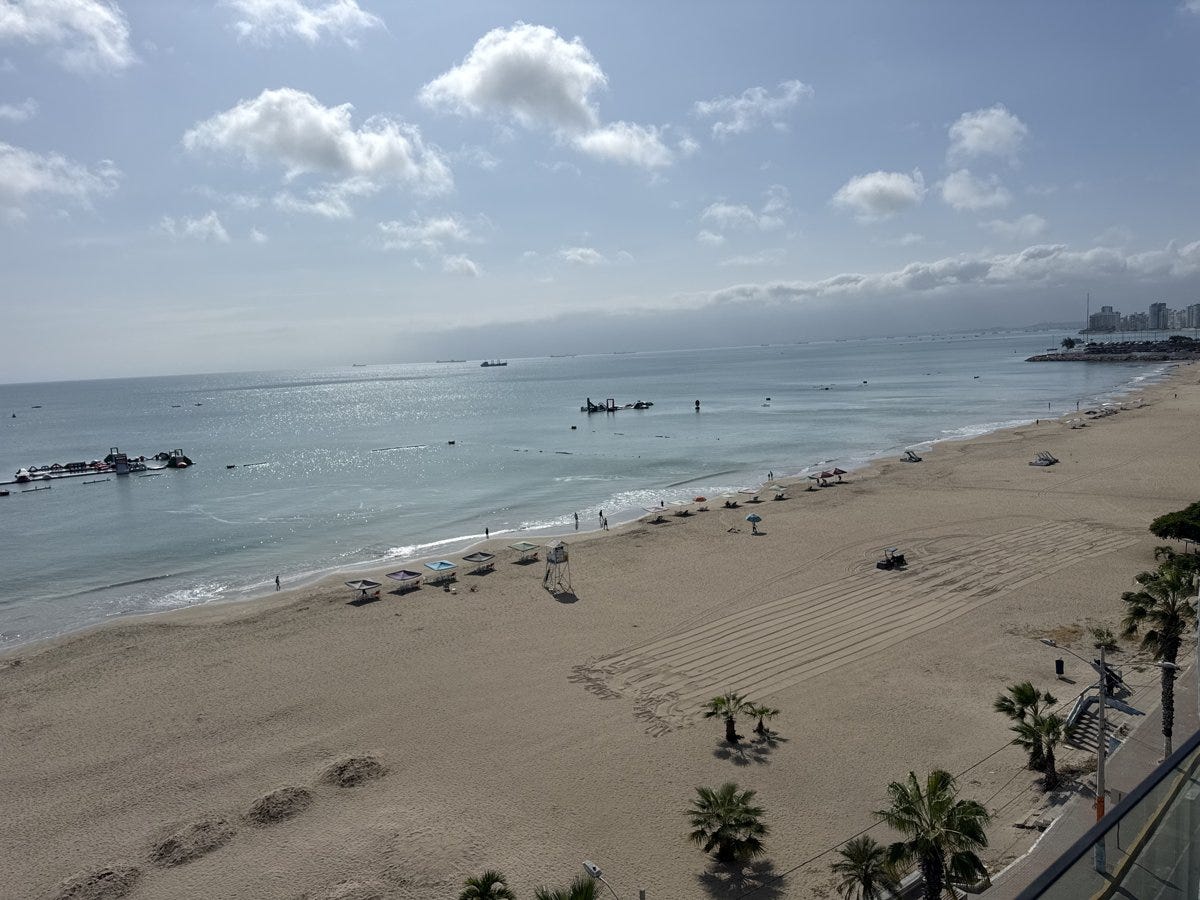
The bay has two main beaches, separated by the Salinas Yacht Club. San Lorenzo, toward the east, is the busier stretch. It sits in front of the malecón, the restaurants, and the tourist pier (muelle turístico). The municipality of Salinas says tourist boats leave from that pier to cruise the bay. The sand can be narrower in places, and this is where you will feel more of the vendors, the weekend crowds, and the water-sports activity.
Chipipe, just west along the same bay, is the calmer, more family-oriented stretch. A 2016 study of the two beaches, published in the journal Tsafiqui and drawing on Ministry of the Environment notes, describes Chipipe as a cove between the yacht club and the cliffs toward La Chocolatera, with a more even, wider beach and gentler surf. That matches how the bay feels when you walk it.
You can walk from one to the other along the malecón. If you only have a day or two, this is enough of an introduction: the sand, the sea air, and a meal facing the water. Weekends and holiday periods are livelier, because Salinas is a straightforward trip from Guayaquil.
A little farther south, Punta Carnero and Mar Bravo are a different kind of outing. The municipality of Salinas notes that the surf there is not suitable for swimming, and that the point is a place to watch the sunset and take photographs. It is a short ride, not a full day trip. If you go, use a referral taxi and agree the fare before you get in.
La Chocolatera and the Puntilla de Santa Elena
The other outing I would not skip is La Chocolatera, at the western tip of the peninsula. It sits inside the Reserva de Producción de Fauna Marino Costera Puntilla de Santa Elena (often shortened to REMACOPSE), a protected area created on September 23, 2008. Ecuador’s official 2026 humpback-whale guide describes it as the most prominent point on the country’s continental coast. The name comes from the way the waves and currents churn the water against the rocks, sometimes in a brownish, chocolate-like color.
The reserve has a circuit of viewpoints linked by marked trails. The municipality of Salinas lists five: El Soplador, La Chocolatera, Gaviotín, the lighthouse (El Faro), and La Puntilla. Go for the views, the birds, and the force of the sea, not for a swim. Official Ministry of the Environment pages, and later visitor rules still cited for the reserve, are clear on this: the water here is dangerous, and the site is for observation. Stay on the trails, do not go past the railings, and do not bring pets.
La Lobería, in the Punta Brava area of the same reserve, is the usual place to look for sea lions (lobos marinos) on the rocks. You may also see marine birds along the point. In whale season, people sometimes spot humpbacks from land here, including from platforms at La Chocolatera. That is a bonus, not a promise.
A few practical notes:
The usual vehicle entrance is through the Base Naval de Salinas. Bring your passport or cédula, because you are passing a military gate. From the gate, Ecuador’s Ministry of the Environment has put the remaining distance to the reserve at about 3.5 kilometers. From the San Lorenzo malecón, a driving route I checked on November 15, 2026 (America/Panama, UTC-5) was about 5 kilometers, or around 10 minutes, depending on the gate and traffic.
Entry has been free. An official Ministry of the Environment bulletin dated January 11, 2022, listed visiting hours as 8:00 a.m. to 4:00 p.m. for entry, with visitors out by 5:00 p.m. Some current visitor listings show an earlier last entry, around 3:00 p.m. Confirm the hours at the naval gate the day you go, and do not count on arriving late in the afternoon.
Wear decent walking shoes and bring water, sun protection, and a real layer. The point is often windy, especially in the cooler months.
I would not walk that stretch from the malecón in the heat. Use a referral taxi called by your hotel or by the guardias at your condo, agree the fare before you go, and say whether you want the driver to wait. An in-town ride in Salinas is usually about $3; this one is a little farther, so expect to pay more and confirm the price, including waiting time, in advance. Do not hail a random taxi on the street.
Humpback whale season
One of the special things this coast offers is humpback whale watching (avistamiento de ballenas jorobadas). Ecuador’s Ministry of Tourism, in its official 2026 whale-watching guide, describes the season as June through October. The municipality of Salinas promotes the season along the malecón from the third week of June, under the name “La gira del amor.” Some earlier official notes, including from the Ministry of Production, described the window as June through September. The whales set the schedule; I would plan on June through October and confirm closer to your dates.
You can sometimes see whales from land at La Chocolatera. The more direct way is a boat trip from the public pier on the San Lorenzo malecón. El Universo reported on June 28, 2026, that Salinas opened that year’s season with about a two-hour outing at $21 per person, boarding at the public pier, with around 20 accredited boats. Primicias, reviewing operators listed in the official 2026 guide, still had a Salinas whale tour listed at $21 on August 6, 2026, and an Ayangue outing listed at $20 for about an hour to an hour and a half. Treat those as recent reported prices, not a promise. Confirm the current fare, the length of the trip, and what is included before you pay.
Go with a licensed operator. The official 2026 guide tells visitors to use tourism operators accredited by the national tourism authority and the municipality, to keep the receipt, and to wear a life jacket for the whole trip — including a child-size jacket if you have children on board. Responsible viewing rules in that same guide are: stay at least 100 meters from a whale, and 200 meters from a mother with a calf; do not cut across their path; and if a whale approaches the boat, the captain should stop and wait. Departures are supposed to follow the port captain’s authorized hours, generally between 8:00 a.m. and 4:00 p.m. Sightings are not guaranteed on any given day.
If you want a longer day in season, a different outing is a trip from Salinas toward Puerto López and Isla de la Plata. That is a full day, not a two-hour bay ride. This Isla de la Plata day trip from Salinas on GetYourGuide leaves from Salinas and heads to Puerto López and Isla de la Plata. Whales are usually seen in the June-through-October window. If you book a tour through that link, a commission may be earned. It does not cost you extra.
Breakfast at the Salinas city market
For a very local morning, go to the Salinas city market, the Mercado Municipal on Avenida 22 de Diciembre and Calle Galápagos. In September 2026 I paid $3.50 there for a bolón, two fried eggs, and a café con leche. That is a current price I paid, not an estimate.
The municipality of Salinas lists the municipal market (Mercado Internacional) among its visitor stops. It is a short taxi ride from the malecón, not a stroll with coffee in your hand. Bring small bills. As I noted in the money guide, markets and small food stands often want cash, and a $50 or $100 bill can be hard to break. Use a referral taxi, and agree the fare before you get in.
Easy day trips from Salinas, Ecuador
Once you have walked the bay and seen La Chocolatera, these are the day trips I think are realistic from Salinas, Ecuador. The driving distances below are from the San Lorenzo malecón, using a route I checked on November 15, 2026 (America/Panama, UTC-5). Traffic, the exact address, and a stop at the Santa Elena terminal can add time. I would do all of these in daylight and be back before dark.
For how to get there, use Getting around Salinas, Ecuador. In short: a referral taxi with the fare agreed in advance, including waiting time if you want a round trip, or a bus along the peninsula corridor, often via the Santa Elena terminal (Terminal Sumpa). An in-town taxi is usually about $3; these trips are longer, so ask first. I do not use ride-hailing apps here, and I would not hail a random taxi on the street.
Ballenita
Ballenita is the closest and the easiest. The drive is about 13 kilometers, or around 15 minutes. It sits just past La Libertad and Santa Elena, very near Terminal Sumpa, and it is a quieter beach town with a malecón, a fishing community, and a hillside lookout. People often mention the Farallón Dillon viewpoint and nautical museum as a stop. I would treat Ballenita as a half-day: a look at a different stretch of coast, a walk, and lunch, without turning it into a project.
Ayangue and Valdivia
Ayangue, a little over 50 kilometers north, or about an hour, is the next step up the Ruta del Spondylus (also called the Ruta del Sol). Ecuador’s official 2026 whale guide, and earlier Ministry of Tourism material, call it the “Piscina del Pacífico” because of its calmer, clearer water. It is a fishing village with a more sheltered bay than Salinas, and it is a realistic place for snorkeling, a boat trip, or a quieter beach day. The same official guide notes its closeness to the El Pelado marine reserve. In whale season, boats also leave from Ayangue.
Just beyond Ayangue is Valdivia, on the same road, at a similar distance of a little over 50 kilometers. The community museum there is a short, worthwhile stop if you are interested in the Valdivia culture, one of the oldest ceramic traditions on this coast. Hours and admission change, so confirm both at the door rather than counting on an old posted price. Ayangue and Valdivia combine well as one day trip.
Montañita
Montañita is farther, about 69 kilometers, or around an hour and 25 minutes. It is a surf town, livelier and younger in feel than Salinas, and a reasonable day trip if you want a change of scene after you have your bearings here. I would start early, leave time for the road, and plan to be back in Salinas in daylight.
Cooperativa Libertad Peninsular (CLP) lists service to Montañita and Olón, with a ticket office at the Santa Elena terminal, as I noted in the getting-around guide. Check the current departure and fare at the window. A referral taxi for the day can also make sense if you are a small group and want the driver to wait; agree the total price before you go.
If you want a night in Montañita instead of a same-day return, look at rooms ahead of time, especially for a weekend.
A simple way to spend a few days
If you are only here for a short stay, I would keep it to this:
Walk the malecón between Chipipe and San Lorenzo, and swim only where the bay is calm and it looks sensible that day.
Take a referral taxi to La Chocolatera, including La Lobería if you want to look for sea lions, and stay on the trails.
Have breakfast at the city market.
If you are here between June and October, book a licensed whale-watching boat from the Salinas pier, or a longer Isla de la Plata day if you want a bigger outing.
Add one day trip: Ballenita if you want an easy half-day; Ayangue and Valdivia if you want a calmer bay and a short museum stop; Montañita if you want the surf-town contrast.
That is plenty. You do not have to see the whole peninsula in one visit.
FAQ
What are the main things to do in Salinas, Ecuador?
Walk the malecón between Chipipe and San Lorenzo, go out to La Chocolatera, and, in season, take a licensed whale-watching boat. Add the city market for a local breakfast, and one day trip if you have another day.
When can I see humpback whales?
The official 2026 tourism guide describes the season as June through October. The municipality of Salinas promotes it from the third week of June. Sightings are not guaranteed on any given day.
How much is a whale-watching tour in Salinas?
El Universo reported $21 per person for a roughly two-hour trip from the public pier when the 2026 season opened in late June, and Primicias still listed a Salinas tour at $21 in August 2026. Confirm the current price before you book.
Is there an entrance fee for La Chocolatera?
Entry has been free. You pass through the naval base, so bring identification, follow the reserve rules, and confirm the day’s hours at the gate.
How do I get to these places without a car?
Use a referral taxi called by your hotel or condo guards, or a local bus as described in the getting-around guide. An in-town taxi is usually about $3. Agree longer fares, including any wait, before you get in.
Is Montañita a realistic day trip from Salinas, Ecuador?
Yes, if you start early and come back in daylight. The drive is a little over an hour, and buses toward Montañita and Olón are part of the peninsula corridor.
Sources
Figures and hours were checked on November 15, 2026 (America/Panama, UTC-5), unless a source is dated earlier below. Confirm them before you travel.
Municipality of Salinas, “Qué hacer y visitar” (main mainland beach resort, about 140 kilometers from Guayaquil; tourism calendar, including whale-season promotions from the third week of June; visitor attractions including beaches, La Chocolatera, and Mercado Internacional): https://www.salinas.gob.ec/index.php/turismo/que-hacer-y-visitar
Municipality of Salinas, “Historia y Generalidades” (La Chocolatera as the most prominent point on the Ecuadorian coast, five viewpoints, REMACOPSE; tourist boats from the Muelle de San Lorenzo; humpback season June–September; Mar Bravo and Punta Carnero not suitable for swimming, used for sunsets): https://www.salinas.gob.ec/index.php/turismo/historia-y-generalidades
Ecuador Ministry of Tourism, Guía de Avistamiento de Ballenas Jorobadas 2026 (season June–October; licensed-operator and safety advice; 100-meter and 200-meter viewing distances; recommended departures 8:00 a.m. to 4:00 p.m.; Salinas pier trips and land viewing at La Chocolatera / REMACOPSE; Ayangue as the “Piscina del Pacífico,” snorkeling, and El Pelado; directory of Salinas and Ayangue operators): https://ecuador.travel/wp-content/uploads/2026/06/2026-CATALOGO_AVISTAMIENTO_BALLENAS_OPERADORAS_compress.pdf
El Universo, June 28, 2026, “La gira del amor” season opening in Salinas (about two-hour trips, $21 per person from the public pier, around 20 accredited boats, mandatory life jackets, season generally June–October): https://www.eluniverso.com/noticias/ecuador/la-gira-del-amor-de-las-ballenas-jorobadas-en-salinas-paseos-de-dos-horas-y-costo-de-21-por-pasajero-nota/
Primicias, August 6, 2026, reference whale-tour prices drawn from the official 2026 operator directory (Salinas $21; Ayangue $20 for about an hour to an hour and a half; Puerto López examples including Isla de la Plata): https://www.primicias.ec/entretenimiento/ballenas-jorobadas-ecuador-manabi-salinas-esmeraldas-feriado2026-tour-precios-129681/
Ecuador Ministry of Production, start of humpback whale-watching season (earlier official description of the season as June through September, including Salinas and Ayangue): https://www.produccion.gob.ec/ecuador-inicia-la-temporada-de-avistamiento-de-ballenas-jorobadas-con-acciones-para-fortalecer-su-comercializacion-turistica/
Ministry of the Environment, “La Chocolatera, la punta más saliente de la costa ecuatoriana” (access through the Salinas naval gate, then about 3.5 kilometers; no entering the water; June–August as busy whale months): https://www.ambiente.gob.ec/la-chocolatera-la-punta-mas-saliente-de-la-costa-ecuatoriana/
Ministry of the Environment, “Sector de La Chocolatera en Salinas cuenta con nueva infraestructura” (free entry; then-published hours 8:00 a.m. to 5:00 p.m.; no litter, smoking, pets, leaving the trails or railings, or driving past the parking area; reserve created by Interministerial Agreement No. 1476, September 23, 2008): https://www.ambiente.gob.ec/sector-de-la-chocolatera-en-salinas-cuenta-con-nueva-infraestructura/
Ministry of the Environment, Water and Ecological Transition, Bulletin No. 014, January 11, 2022 (visit sites including La Chocolatera, Mar Bravo, Punta Carnero, and La Lobería; official visiting hours Monday–Sunday, entry 8:00 a.m. to 4:00 p.m., visitors out by 5:00 p.m.): https://www.ambienteyenergia.gob.ec/ambiente/puntilla-de-santa-elena-una-de-las-areas-protegidas-mas-visitadas-en-el-2021/
C. M. Villón Toasa and D. G. Vilema Vizuete, “Estimación de capacidad de carga comercial en las playas de San Lorenzo y Chipipe, Salinas,” Tsafiqui, no. 8 (2016) (San Lorenzo and Chipipe as the two main urban beaches, separated by the yacht club; Chipipe as a wider, calmer cove): https://doi.org/10.29019/tsafiqui.v0i8.165
Ecuador Ministry of Tourism, “Ayangue, ‘la piscina del Pacífico’ ecuatoriano” (official nickname and description of Ayangue): https://www.turismo.gob.ec/ayangue-la-piscina-del-pacifico-ecuatoriano/
CLP (Libertad Peninsular), official site (routes including Guayaquil–Montañita–Olón and a ticket office at the Santa Elena terminal), as also cited in the getting-around guide: https://clp.com.ec/
OpenStreetMap / OSRM driving routes checked on November 15, 2026, America/Panama (UTC-5), from the San Lorenzo tourist pier (approximate road distances and times used above): https://www.openstreetmap.org/ and https://router.project-osrm.org/